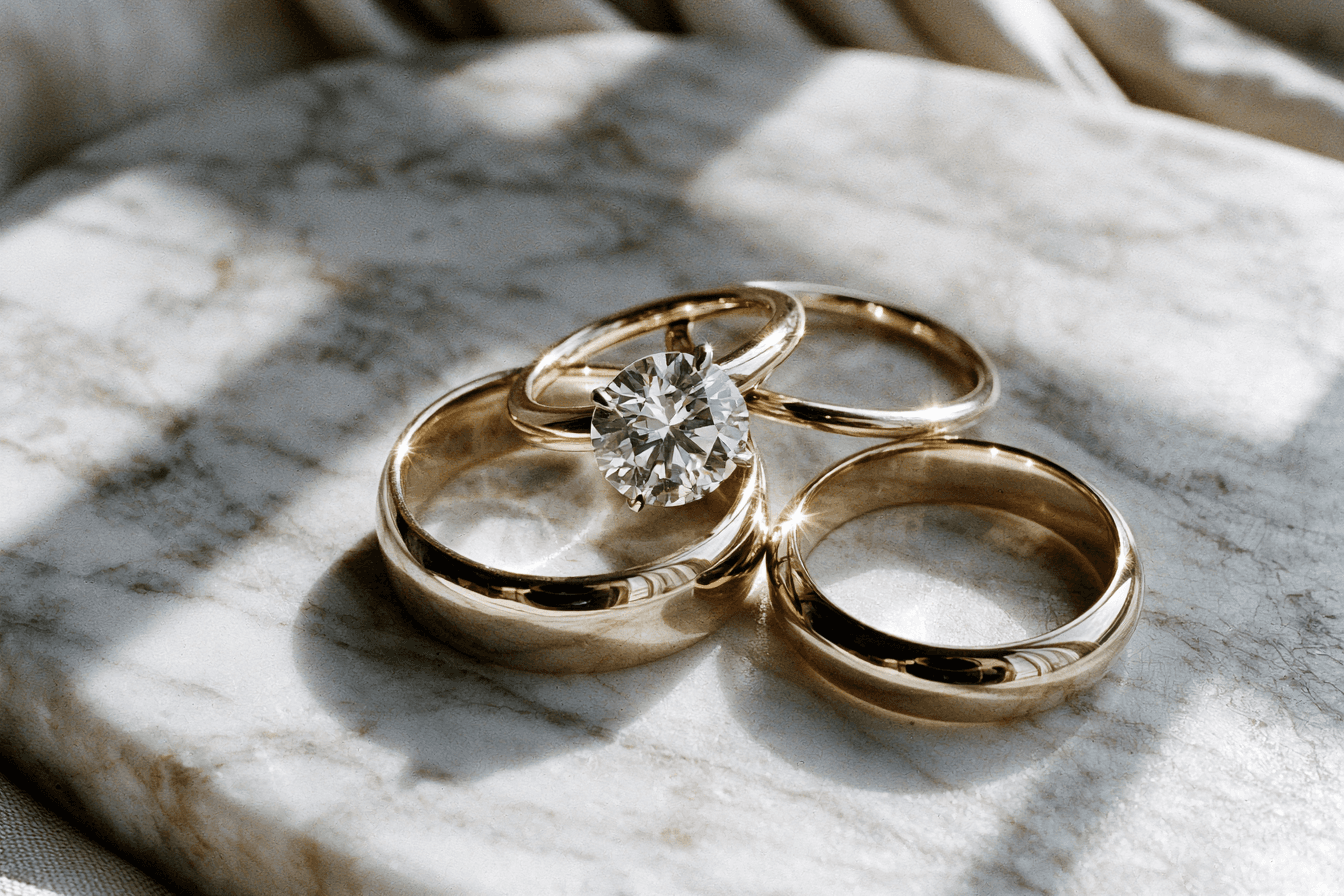
Someone, at some point, told you the number. Three months' salary. Or two. Or "whatever you can afford, but make it count."
They said it as if it were a natural law, one of those carved in stone. And yes, it does come from stone, but not in the romantic sense.
The short answer
The months-of-salary rule for engagement rings isn't an ancient tradition: it became popular through diamond industry advertising during the twentieth century, and the figure changed over the years and by country. There is no correct amount. What's reasonable is a sum that doesn't create expensive debt, that doesn't take money away from the wedding or the life beginning after, and that's been discussed—even if the proposal itself is a surprise.
Where the number came from
Engagement rings have existed for centuries. Diamonds as a requirement, not as long. And measuring them in salaries is even more recent.
During the twentieth century, the diamond industry invested heavily in advertising to establish an idea: commitment equals diamond. In 1947, the agency handling that account wrote "A Diamond Is Forever," a tagline that decades later was recognized as one of the most influential slogans of the century.
The salary standard arrived the same way and kept climbing. Ads from that industry first suggested one month's salary; by the eighties, some were already talking about two. And in certain countries, the expectation reached two or even three months. It wasn't a single campaign or a universal rule: it was a figure adjusted to whatever market they wanted to reach.
No one in that story was thinking about your relationship. They were thinking about the next quarter.
That doesn't make diamonds bad or wanting a beautiful ring ridiculous. It just takes away from the number the moral authority it never had.
Why the rule is still alive
Because it turns an uncomfortable decision into a formula. Talking about money before proposing marriage feels unromantic, so a rule from outside solves the conversation without having to have it. And because it mixes two things that have nothing to do with each other: how much you love someone and how much an object costs.
It also survives through social pressure. The ring is shown, photographed, posted, commented on. No one likes a photo of the emergency fund you didn't spend.
Measuring love in paychecks sounds absolutely odd the moment you think about it for two seconds. Which is why it's worth thinking about for two seconds.
What should actually determine the amount
Debt. A ring charged to a credit card with monthly interest can end up costing significantly more than its price tag. Starting a marriage paying interest on the symbol of marriage is an expensive irony.
What comes next. There's almost always a wedding, sometimes a move, sometimes travel. Every dollar on the ring is a dollar not going there. It's worth looking at the complete budget before setting a single line, starting with who pays what in the wedding.
What she actually wants. Some dream of a large diamond and others feel uncomfortable wearing something expensive on their hand every day. Some prefer a colored stone, a family ring, or a simple design. Guessing is risky; finding out indirectly, or with help from someone close, almost always works.
Daily wear. A very expensive ring gets worn on the subway, at the office, and at the grocery store. If it's going to give you anxiety every time you put it on, it's too much ring for your life.
| If… | Then it's wise to… |
|---|---|
| You'd have to pay it with interest-bearing debt | Lower the amount or wait |
| There's still no wedding budget | Look at it together before buying |
| You don't know what she likes | Find out before setting the amount |
| You'd be afraid to wear it on the street | Think about a design you can actually wear |
The verdict
In our opinion, three months' salary doesn't measure love or the lack of love. This isn't an ancient romantic law: it's marketing that has aged very well.
The right ring is one you can wear without debt, without fear, and without guilt. Whether it costs one month's salary, three, or a fraction, it doesn't matter. What does matter is starting a marriage with a financial decision written by an advertising executive nearly eighty years ago.
Next step
Before walking into a jewelry store, do this today:
- Define how much you can pay in cash or in interest-free installments, without touching your emergency savings.
- Subtract that from the money you're planning to spend on the wedding and check if what's left can still cover an achievable celebration.
- Find out what she likes: metal, shape, size. That saves more than any discount.
And if you've already moved from the ring to the wedding, the next expensive mistake is usually hiring vendors in the wrong order. When that time comes, Katiblé can tell you what you need and compare proposals from vendors.
Frequently asked questions
Where does the three-month salary rule come from?
From diamond industry advertising during the twentieth century. Ads first suggested one month's salary; by the eighties, some were already talking about two, and in certain countries the expectation reached three. It's a commercial figure that changed over time, not an ancient tradition.
When was "A Diamond Is Forever" created?
- It was written by the advertising agency that handled the diamond industry account, and over the years it became one of the most recognized slogans of the twentieth century.
How much is spent on average for an engagement ring in Mexico?
There is no reliable official Mexican statistic on engagement ring spending. The figures that circulate usually come from jewelers or surveys from other countries. What's useful isn't the average, but what you can actually pay without debt.
Is it bad to buy the ring on installments?
It depends on whether they're truly interest-free installments and whether the payment fits comfortably in your budget. What's worth avoiding is debt with interest: it makes the ring end up costing much more than what the tag says.
Does it have to be a diamond?
No. The diamond as a standard was solidified largely thanks to that same advertising. There are rings with other stones, family rings, and designs without stones. What matters is that whoever will wear it likes it.
Is it unromantic to talk about the ring budget?
Less romantic than starting a marriage with debt no one discussed. You can talk about money and keep the surprise: the date and moment can be secret even if the range isn't.
Calculate how much your wedding gives back
Estimate the cashback your wedding could generate once it is enabled: your guests book hotels, transfers and experiences. It is not enabled yet.
For vendorsGet listed in the Katiblé catalogue
We don't send you fake leads — we send the ones who actually book. Your clients plan their events here and find you.