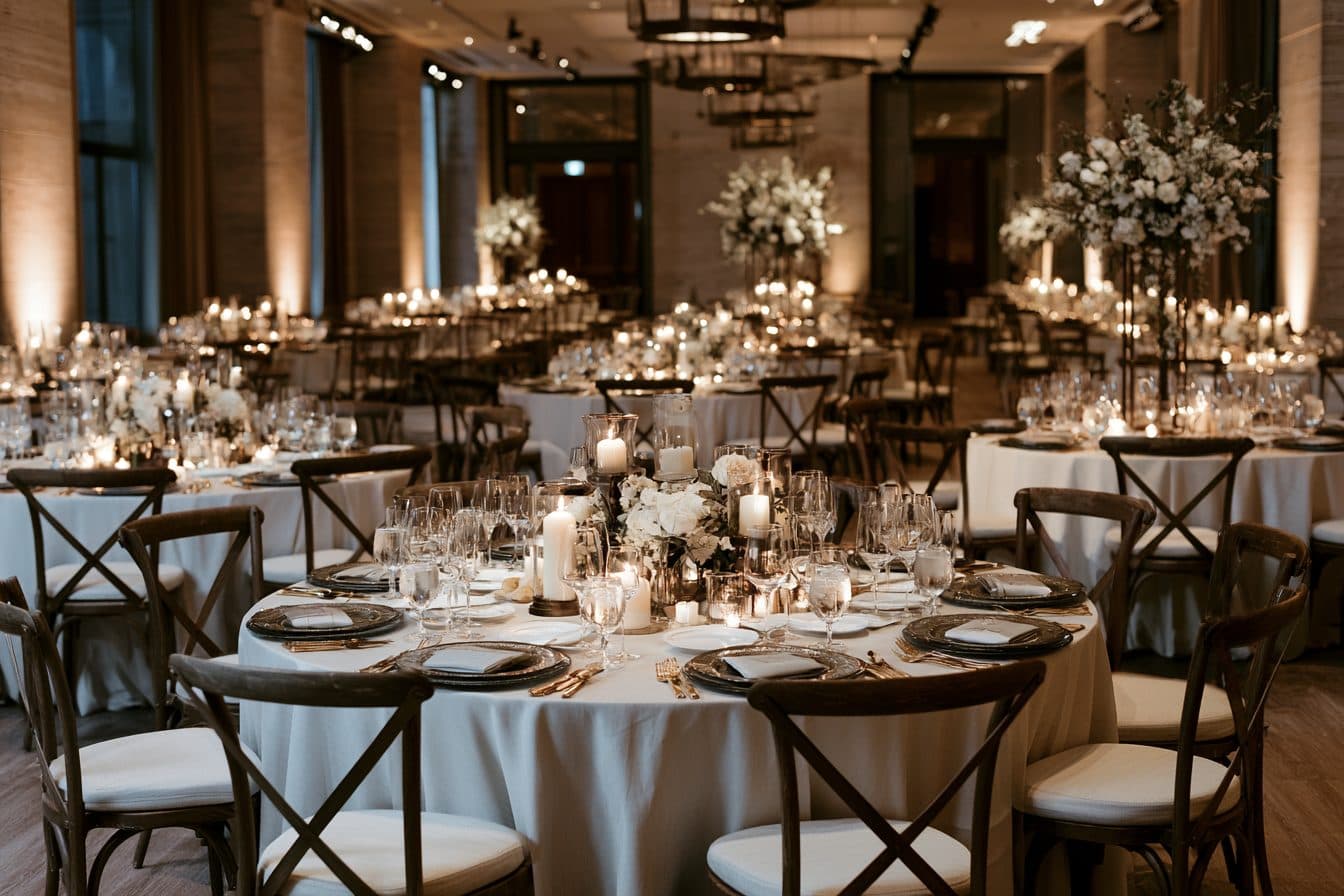
Riviera Maya Wedding Décor: The Guide Pinterest Doesn't Give You
There's something almost nobody tells you when you start planning your wedding in the Riviera Maya: the décor you see on Pinterest was photographed at five in the afternoon, with calm winds, and likely stayed standing for exactly the duration of the photo shoot.
Decorating in front of the Caribbean Sea is more stubborn and far more interesting. Here, the climate isn't background detail—it's the invisible supplier that has the final say on your flowers, your fabrics, your lighting, and your stationery. If you understand this from the beginning instead of fighting it, you'll end up with a wedding that looks better—not worse—than the photograph. This guide is so you arrive at your first quotes knowing what to ask for, what to ask about, and what to dismiss.
And if you don't yet have your budget, the Katiblé calculator estimates it with your guest count and destination—free and in one minute.
The Four Forces That Rule Wedding Décor in the Riviera Maya
Everything you decide will encounter these four. None of them are negotiable.
Wind. Along the coast, a breeze picks up in the afternoon, right at ceremony hour. It usually calms as the sun sets, but not always. It defines, more than anything else, what structure, fabric, and floral arrangement are viable. The vendor who doesn't mention this in their proposal hasn't worked enough on the beach.
Salt and humidity. Salty air oxidizes metals, clouds surfaces, and softens paper. Humidity curls cards and makes fabrics hang differently than in the showroom. Printed menus that look perfect at six can be wavy by eight.
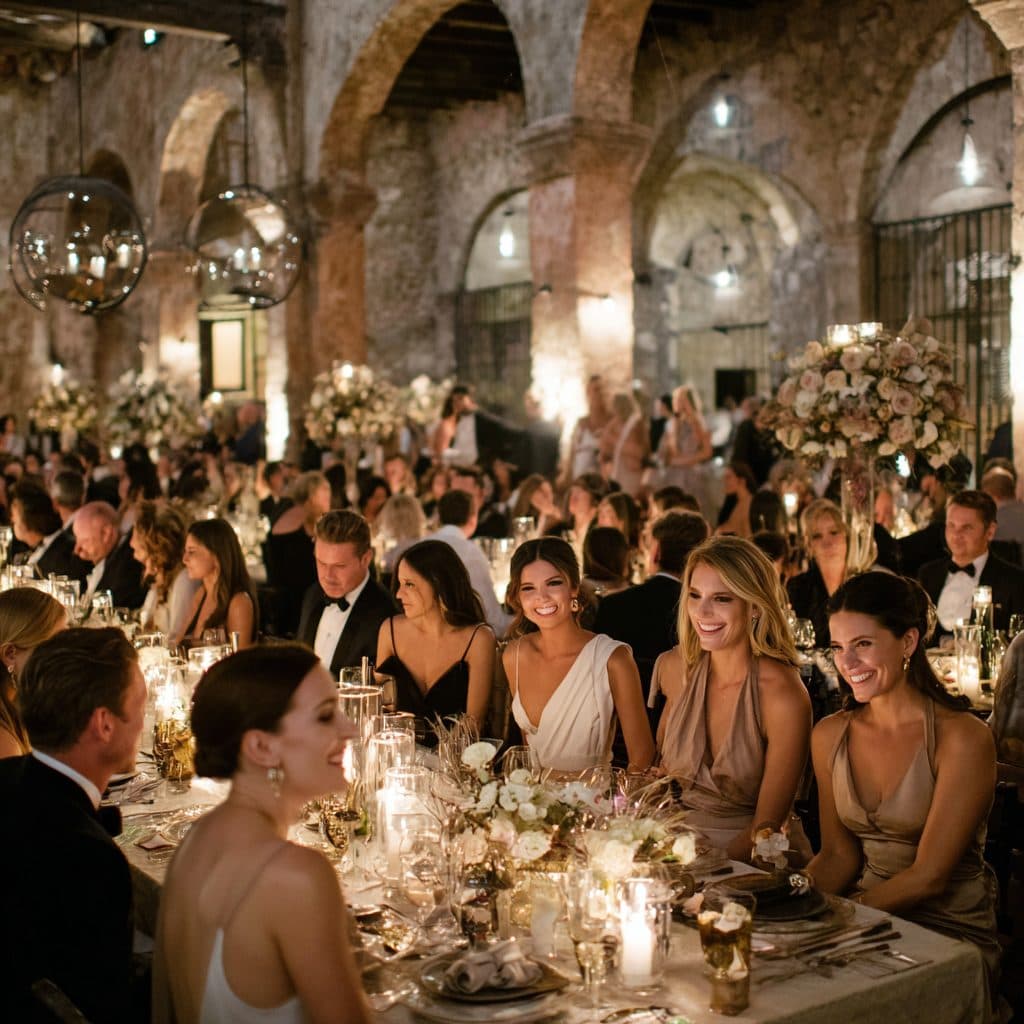
Light. It's the best argument for getting married here: the sunset over light sand is diffuse, golden, and flattering. But it's short—it goes from spectacular to nonexistent in half an hour. Your artificial lighting isn't secondary décor: it's what sustains your 7 p.m. and beyond wedding.
Sand. It doesn't support point loads. Everything that's heavy and lacks a wide base sinks, tilts, or falls. And a crooked pillar ruins a photo that took months to plan.
Ceremony: Pergola, Arch, or Nothing
The most important structural decision is where and how the ceremony stands.
On open beach, any vertical structure becomes a sailboat. A wooden pergola with four posts and buried foundation holds up; a round arch lined with fabric without anchoring doesn't. Ask your vendor explicitly how they'll anchor the structure: if the answer is "with sandbags on top," ask them to show you photos of that same structure installed on a windy day.
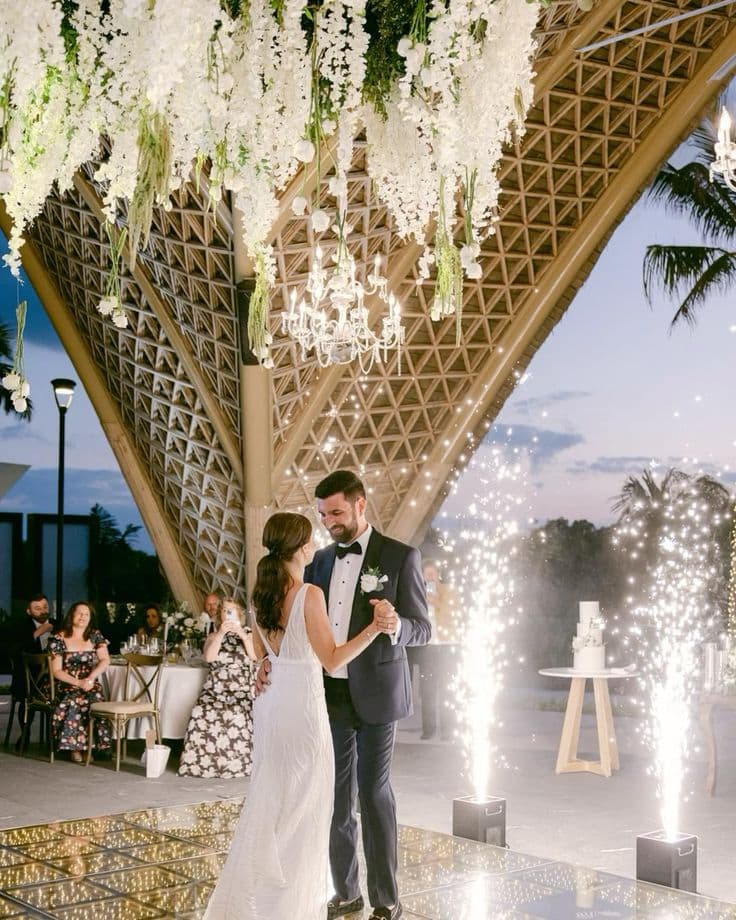
Under a palapa or on a covered terrace, everything opens up: hanging installations, suspended arrangements, long fabrics. It's the most flexible option and the one most resembling what you saw on Pinterest.
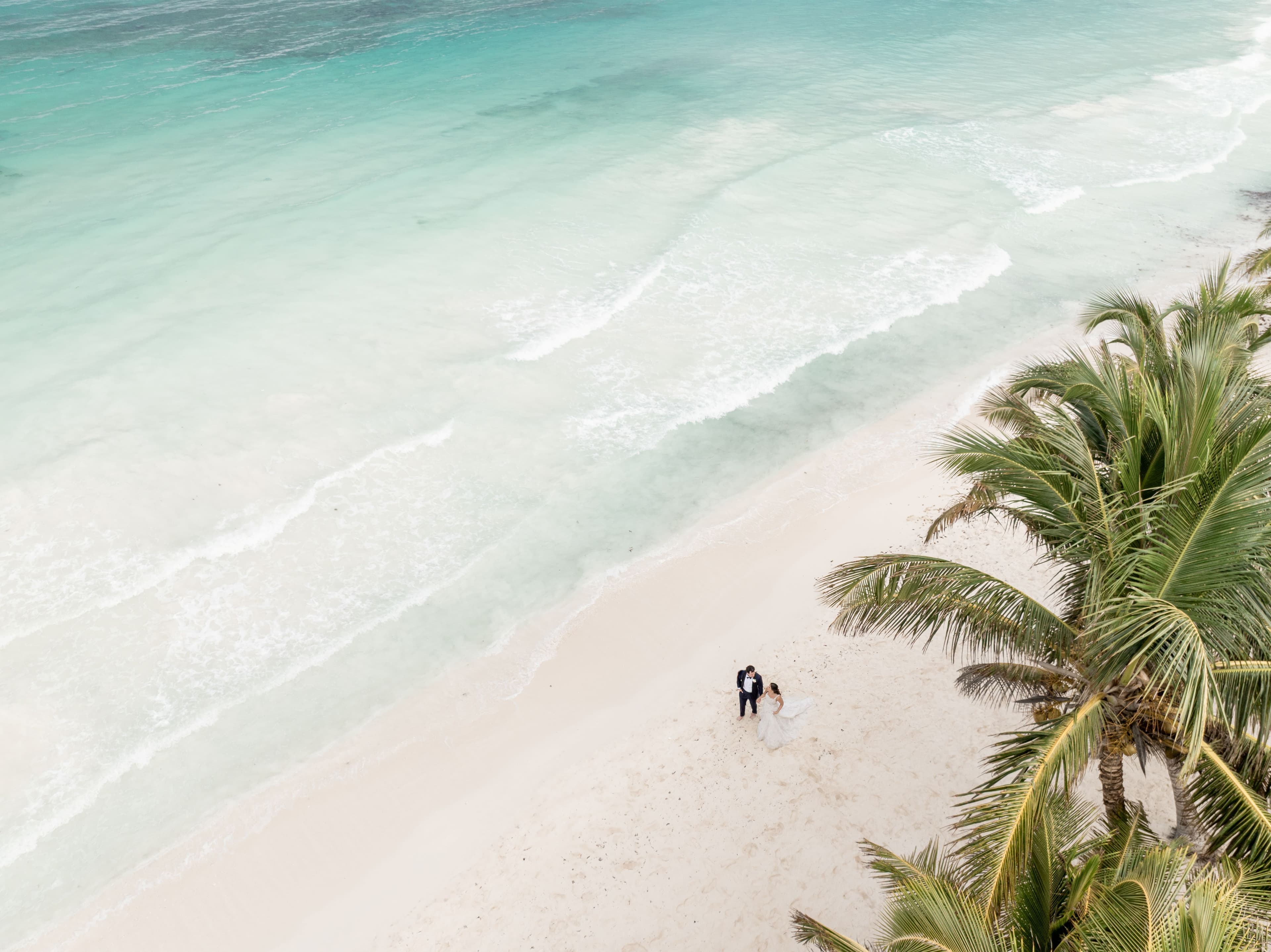
Without a structure is also a design decision, not a compromise: in the Riviera Maya the background already is the sea. An aisle marked with low arrangements and nothing competing with the horizon is one of the most elegant ceremonies you can create, the most wind-resistant, and usually frees up budget for the reception—where your guests will spend six hours.
One detail almost always forgotten: chairs sink. If the ceremony is on sand, ask for a platform or support plates. A guest wrestling with a tilted chair during vows is a cost that doesn't appear on any quote.
Flowers: Which Ones Endure and Which Surrender
This is where the most money is lost from not asking.
Temperate-climate flowers—peonies, hydrangeas, garden roses, ranunculus—are the ones that appear most on inspiration boards and also the ones that tolerate Caribbean heat and humidity the least. They open too much, tire quickly, and lose color in hours. It's not impossible to use them: it's that they need real refrigeration, late installation, and often replacement between ceremony and reception. All of that costs.
The ones working with the climate are different: orchids, anthuriums, heliconias, bird of paradise, protea, ginger, bromeliads, with hard-leaf foliage like monstera, palm, and banana leaf. They withstand heat, sun, and air movement. And they're visually coherent with where you are: nobody arrives in the Riviera Maya looking for a wedding that looks like the English countryside.
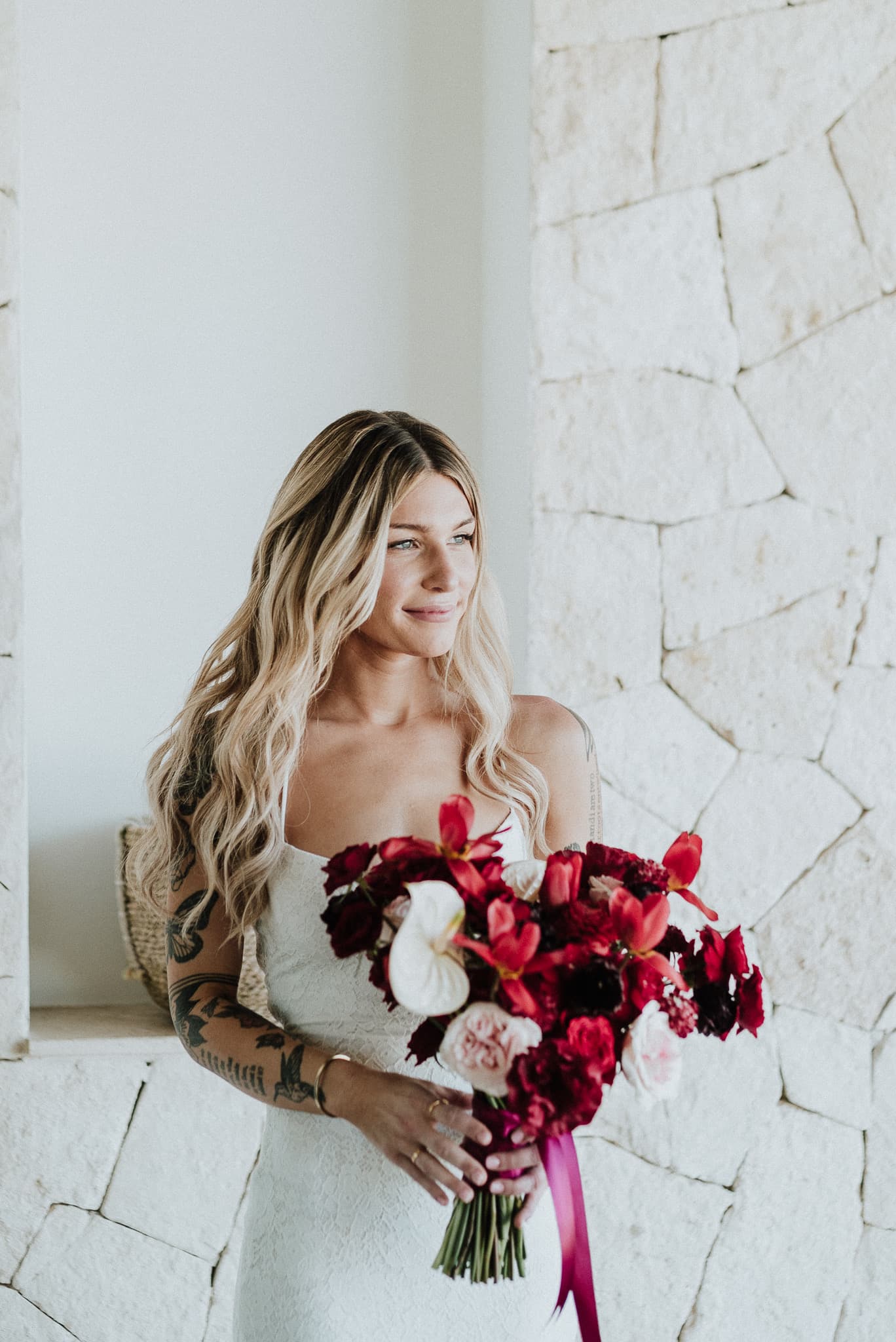
If your palette demands delicate flowers without negotiation, there's a middle ground that works very well: tropical, resistant base in large, exposed arrangements (ceremony, entrances, tall arrangements) and delicate flower only where there's shade and control: bridal bouquet, table centers under the palapa, boutonnières. The close-up photo—the one you'll frame—keeps the delicacy; the overall structure doesn't collapse.
Always ask your florist these two things: what time they install (the later, the better: each extra hour under the sun shows) and whether the arrangement is designed to withstand wind or only to look good in a five p.m. photo.
Furniture and Fabrics: Crisp, Heavy, and Well-Chosen
Round tables for 10 to 12 people: on the coast they work better than long tables. Better conversation, faster reconfiguration if you need to move everything indoors for rain, and they present less flat surface to the wind.
Linens: heavy, long, and pressed. Wrinkled linen isn't "relaxed," it looks careless on camera. If there's a breeze, ask for discreet weights at the corners.
Hanging fabrics and drapes: beautiful under a roof, problematic on open beach. Outdoors, tensioned at both ends, never hanging loose.
Materials salt doesn't forgive: brass, copper, and untreated iron stain quickly. Prefer glass, ceramic, wood, and rattan, which also read better with the setting.
Lighting: What Actually Holds Up With Breeze
An unpopular but honest tip: string lights hanging are fragile on the coast. With wind they swing, project moving shadows, and if they're not tensioned between firm points, they sag.
What does work, and looks far better in night photography:
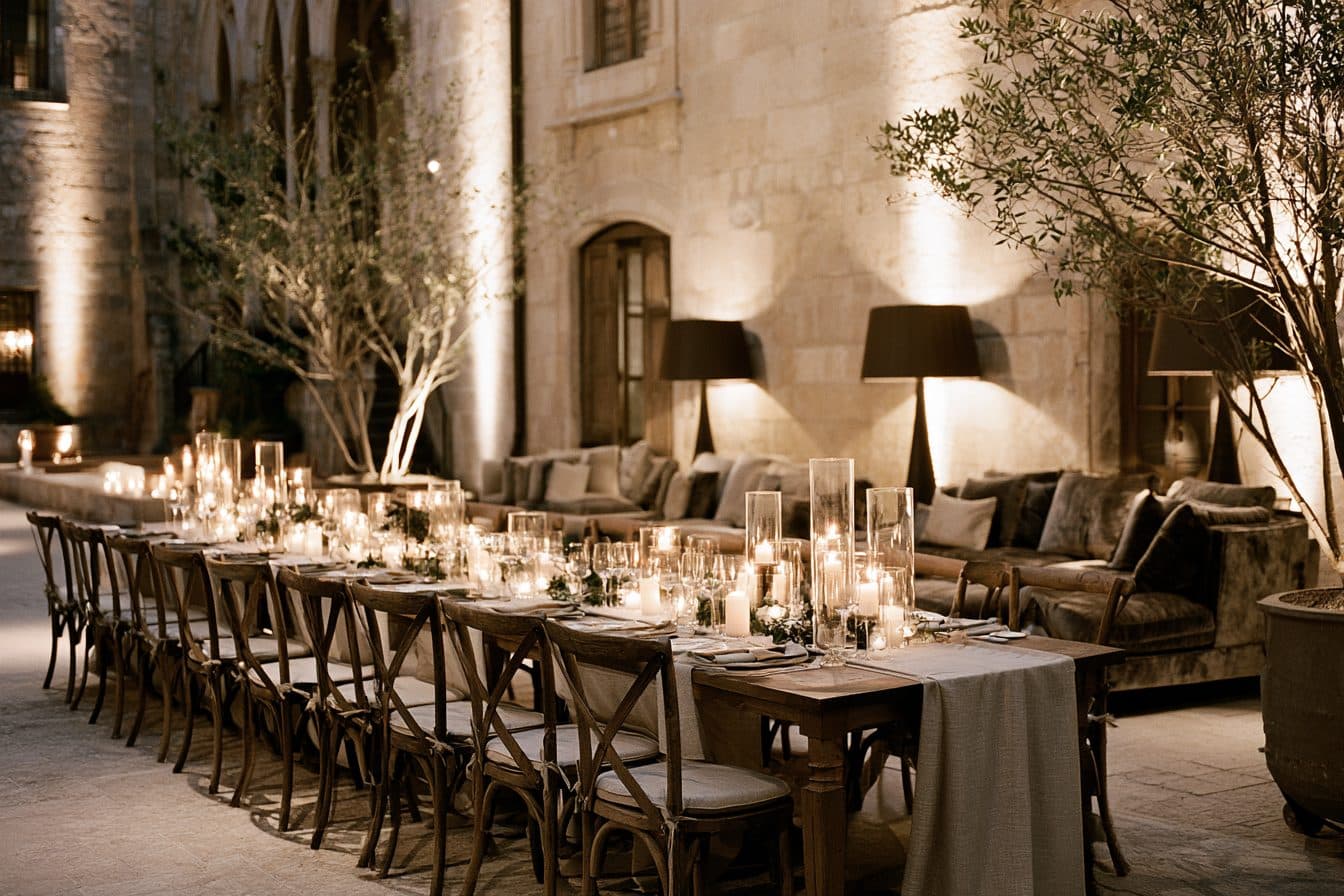
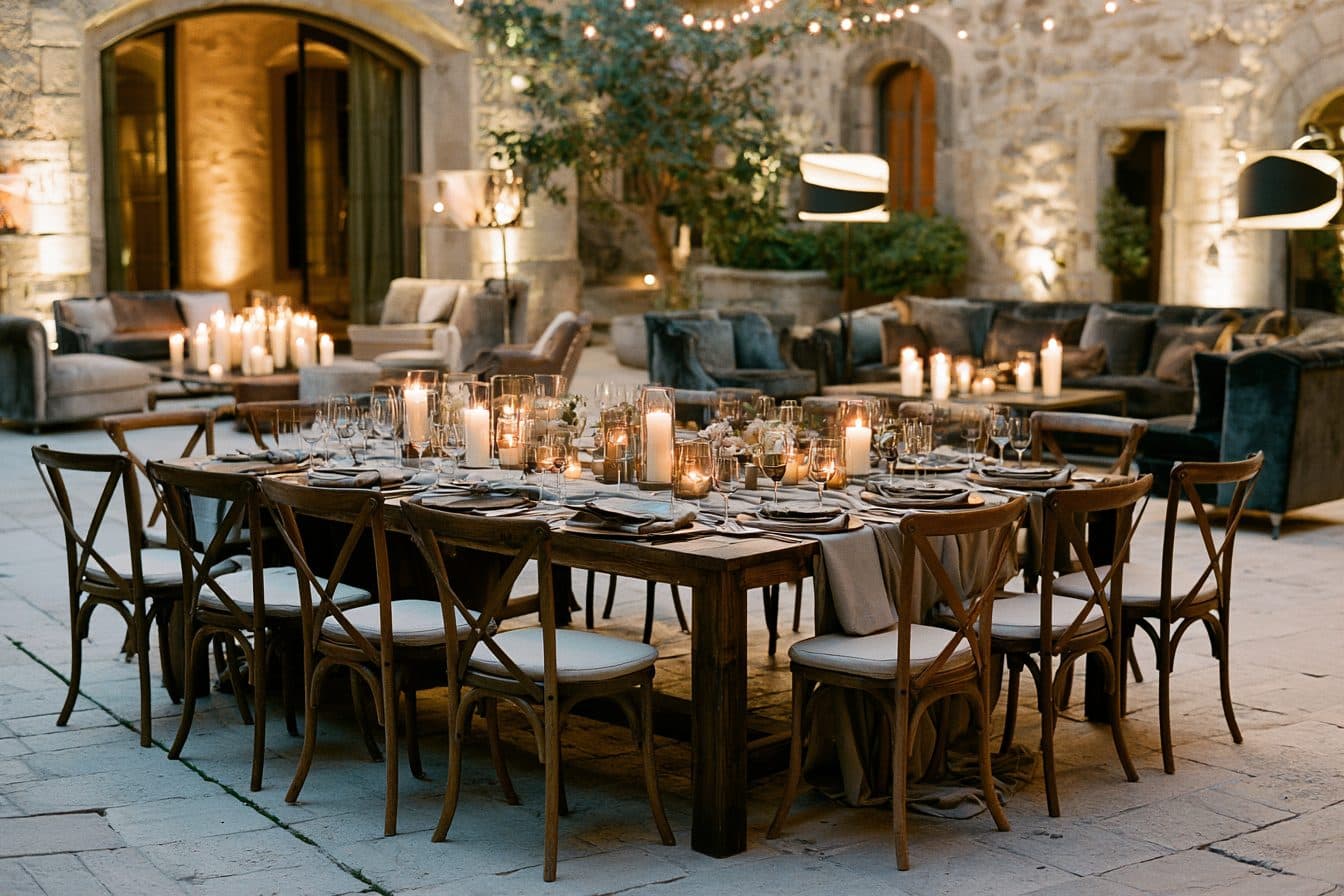
- Pillar candles inside glass. The glass protects the flame from the air; exposed candles blow out in the first minute.
- Luminous spheres and lanterns on the ground or hanging from firm structure. Volume of light without exposed wire.
- Warm upward light on palms and walls. High impact, zero fragility.
- Torches or ground lighting marking aisle and access points.
And a test you can demand: ask your vendor for a real night photograph of an installation of theirs, not a render. In lighting, the render always lies in its favor.
Stationery, Seating Chart, and Printed Details
Humidity warps paper. If your menu, program, or place cards will be on a table in the open air for hours, choose high-weight paper or rigid cardstock, avoid finishes that stick in heat, and anchor them: under the plate, inside the napkin, or held down by something with weight.
The seating chart on a large panel is another wind hazard: a flat, vertical panel on open beach is literally a sail. Either it goes under a roof, it's anchored to a heavy, wide base, or you switch to individual cards.
Plan B: It's Not Optional, It's Part of the Design
In the Riviera Maya it rains, and when it rains, it rains hard and fast. A Plan B isn't admitting defeat: it's responsible design.
Ask this question of your venue and your decorator, in these words: "At what time is the decision made to move everything indoors, who makes it, and how long does the team take to execute the change?" If nobody gives you a concrete time and a concrete setup window, you don't have a Plan B: you have a hope.
And a second, uncomfortable but necessary one: does the Plan B look good? An empty ballroom with the same flowers on top isn't a Plan B, it's another wedding. The décor must work in both scenarios: arrangements that move without falling apart, lighting that exists in both spaces, furniture that reconfigures.
Beach Permits and Logistics
The beach strip in Mexico is federal zone and not all sections can be used or decorated freely. In practice, most weddings are set up on beaches administered by hotels or venues that have already resolved the permit. Even so, confirm it in writing before signing: ask your venue if the setup you're planning is allowed on their stretch, what hour and volume restrictions exist, and until what time outdoor music is permitted. A decorator with experience in the area knows these rules by heart; one brought from another city sometimes doesn't.
How to Choose Your Decorator
Three questions separate those who know from those who improvise:
- "Show me one of your weddings on open beach, with wind, not under a palapa." If their entire portfolio is indoors, your wedding will be their first experiment.
- "What flowers do you recommend for this date and why?" The correct answer mentions season, heat, and resistance, not just aesthetics.
- "What does the same setup look like in Plan B?" If they haven't thought it through, they haven't solved it.
And something almost nobody does: ask for photos of the setup at ten p.m., not at six in the afternoon. That's the hour your guests will be living your wedding.
At katiblé we bring together Riviera Maya vendors so you can compare actual proposals and get fast answers without chasing quotes over WhatsApp for weeks. Publishing your wedding is free and vendors come to you.
What Flowers Best Withstand Riviera Maya's Climate?
Tropical and firm-structure ones: orchids, anthuriums, heliconias, bird of paradise, protea, and bromeliads, with hard-leaf foliage like monstera and palm. Temperate-climate flowers—peonies, hydrangeas, open garden roses—are the most fragile against heat, humidity, and sun, and usually require refrigeration, late installation, and in some cases replacement between ceremony and reception. A good strategy is to use tropical flowers in large, exposed arrangements and reserve delicate flowers for the bouquet and shaded spaces.
Can Any Beach in the Riviera Maya Be Decorated?
Not freely. The beach strip in Mexico is federal zone and its use is regulated, so most weddings are set up on beaches administered by hotels or venues that have already resolved the permit. Before signing, confirm in writing with your venue if the setup you're planning is allowed on their stretch, what hour and volume restrictions exist, and until what time outdoor music is permitted.
How Early Should I Set Up Wedding Décor on the Beach?
As late as possible within logistics constraints. Each hour flowers spend under sun and salt shows in the final result. A decorator with coast experience installs exposed arrangements as close to ceremony time as possible and leaves only the structural setup for before: platform, chairs, pergola, and lighting. Always ask setup time: it's one of the clearest signals of whether the vendor has worked on the beach or not.
Is It Worth Bringing a Decorator From My City Instead of Hiring a Local One?
It can work, but only if that person has already worked on the coast. Without beach experience, wind, humidity, and local setup rules are usually underestimated, and setup costs, lodging, and furniture rental that aren't available in the area add up. If you love their style, a common solution is for them to direct the design and work with a local setup team that knows the terrain.
How Do I Keep Wind From Ruining the Ceremony?
By designing with the wind, not against it: anchored structures with wide bases instead of lightweight arches, fabrics tensioned at both ends and never hanging loose, candles inside glass instead of exposed flame, low arrangements with weight on the sides of the aisle, and stationery with sufficient weight or anchored. The ceremony without a structure, with the sea as the only backdrop, is both the most wind-resistant option and one of the most elegant.
Frequently Asked Questions
Does Caribbean Humidity and Wind Ruin the Décor?
Not if you design for the climate. Beach wind topples tall, narrow arrangements, and humidity wilts delicate flowers in hours. Setups that endure are low and wide, with resistant foliage and anchored structures. Ask your florist to show you photos of their outdoor setups after four hours, not at installation time.
Can I Bring My Own Decorator to a Resort?
It depends on the resort and it's one of the first things to ask. Many charge a fee per outside vendor or directly prohibit it. If you have a decorator you absolutely want, confirm it in writing before booking the venue, not after.
How Long Before the Wedding Is Beach Décor Set Up?
Less than you'd think. On sand the setup usually happens the same day with a short window, because sun, tide, and wind don't forgive. That increases labor costs and limits what can be assembled. Ask how many hours of access your vendor has to the space.
Should I Use Local or Imported Flowers?
Local, almost always. They withstand the climate better, cost less, and don't depend on a flight that might be delayed. Imported flowers make sense for a specific detail, not for the entire setup.
Is Ceremony Décor Reused for the Reception?
Yes, and it's one of the cleanest savings that exist. The arch, floral pathways, and ceremony arrangements can move to the reception if you plan it from the design. Request it explicitly in your quote—many vendors don't offer it if you don't ask.
See what your wedding will cost
An estimated budget based on guest count and destination. Free, in about a minute.
For vendorsGet listed in the Katiblé catalogue
We don't send you fake leads — we send the ones who actually book. Your clients plan their events here and find you.
Planning your wedding in Riviera Maya?
Sign up free and get your WeddingCode to earn cashback on every booking.
Sign up free