Best Time to Get Married in Riviera Maya: Month-by-Month Guide (Weather, Sargassum & Hurricanes)
Choosing a date for a wedding in Riviera Maya is not simply selecting a pretty day on the calendar. It is choosing a climate, a sea, and a budget—all three at once.
The coast of Quintana Roo has something that San Miguel de Allende and Querétaro do not: here the year opens three distinct conversations—rainfall, sargassum, and hurricanes—and each one runs on its own calendar. They overlap, but they do not coincide. Knowing where they intersect is the difference between a date that works in your favor and one that forces you to improvise three weeks before.
I'll walk you through what the full year looks like, with the best and most challenging aspects of each period.
The Three Variables That Shape Your Date (And They're Not the Same)
Most couples arrive thinking that "rainy season" covers everything. It doesn't.
- Climate. The peninsula has two clear seasons: dry from November to April, and rainy from May to October. Rains are typically short and intense, almost always in the afternoon.
- Sargassum. It is a marine phenomenon, not a meteorological one. It arrives with ocean currents and is not predicted in weather forecasts. Its season runs approximately May to October, with peaks concentrated between May and August according to monitoring by UNAM's National Laboratory for Earth Observation.
- Hurricanes. The Atlantic hurricane season officially runs from June 1 to November 30. The period of highest activity spans mid-August to mid-October, with the historical peak around the second week of September.
Pay attention to this important detail: you can have a flawless day without a drop of rain and still find sargassum along the shore. And you can marry in September without seeing a single cyclone. These are independent risks, and each one is managed differently. Treating them as one is what leads to expensive decisions.
Peak Season and Low Season: How They Impact Your Budget
Peak season in Riviera Maya runs from December to April. Low season, from May to November.
This means that the year's best weather coincides precisely with the highest rates and greatest competition for dates. December through April gives you comfortable temperatures—between 73 and 86 degrees Fahrenheit—cool evenings, sunny days, and virtually no sargassum. It also gives you full hotels, venues booked well in advance, and expensive flights for your guests.
It's worth remembering something that gets overlooked in destination weddings: you don't pay for everything. Your guests pay for flights and accommodations. A peak season date makes the wedding more expensive for twenty, fifty, or one hundred people at once, and that directly impacts confirmation rates.
Low season inverts the equation: more accessible rates, greater availability, more room to negotiate with vendors. In exchange, you assume climate risk. It's not a bad season. It's a season that demands a plan.
The Month-by-Month Calendar
December through February. The year's most stable climate and virtually no sargassum. January is the coolest month, with cool evenings that enhance an open-air reception. It's also the most in-demand period: Christmas, New Year's, and winter vacation from the north compete for the same rooms. If you want these dates, the conversation with your venue begins well in advance.
March and April. These tend to be the most balanced months: dry, warm without being oppressive, clean ocean most of the time. The caveat is Holy Week, which fills the coast and raises rates. Toward late April, the first sargassum reports begin to appear.
May. The month of ambiguity. Rates drop because low season begins, the hurricane season hasn't officially started, and the climate holds. But it's also one of the months with the highest sargassum arrival. If your wedding is beachfront, May is when you most want a well-defined alternate plan.
June, July, and August. Heat, humidity, and afternoon rains. Sargassum at its highest probability. August enters the active period of hurricane season. These months offer attractive rates and are perfectly viable, but they lose much appeal if your vision is a beachfront ceremony. They gain considerable advantage if you move it to a cenote, jungle, hacienda, or covered rooftop.
September and early October. The year's highest-risk period. The historical peak of cyclone formation falls around the second week of September, and October tends to be among the most humid months. It's the cheapest time of year and also the one that requires the most protective contract. It's doable. It's not improvised.
November. The window almost nobody contests. The hurricane season officially closes on November 30, but the active period is already past; the dry season begins, the ocean is typically clean, and rates haven't yet climbed to December levels. If I offered a single recommendation for the climate-to-price ratio for a coastal wedding, it's November.
How to Protect Your Date, Whichever You Choose
No date is safe on its own. What protects you is not the month: it's what you have in writing.
Contract Plan B from day one, not as an afterthought. "We have a room in case it rains" is not a plan. A plan is an indoor space with capacity for your actual guest count, included in the contract, with clarity on who decides the change and what time the decision is made. If Plan B is activated at four o'clock on your wedding day, someone else has already decided for you.
Request a force majeure clause in writing. What happens if there's an official alert, if they close the airport, if the hotel evacuates. What's refunded, what's credited, when you can reschedule, and without what penalty. This paragraph is worth more than any décor detail.
Ask about event insurance. Policies exist that cover cancellation and rescheduling due to weather. They typically have one key condition: they're contracted before a storm has a name. If your date falls between June and November, this conversation happens at the start of planning, not the end.
Verify sargassum with evidence, not promises. Ask your venue for photos from the same week in previous years. Ask if they have containment barriers and their own cleaning crew, and what time they clean. Check public monitoring reports before committing to a specific beach: sargassum varies beach by beach and day by day, so a regional average won't help you decide.
Lock in your room block with clear dates. In peak season, your guests need early certainty; in low season, you need certainty that the hotel won't release your block prematurely. It's the same tool with two different uses.
And If Your Vision Is the Beach, But Your Date Carries Risk
There's an option almost nobody considers in time: separate the postcard from the risk.
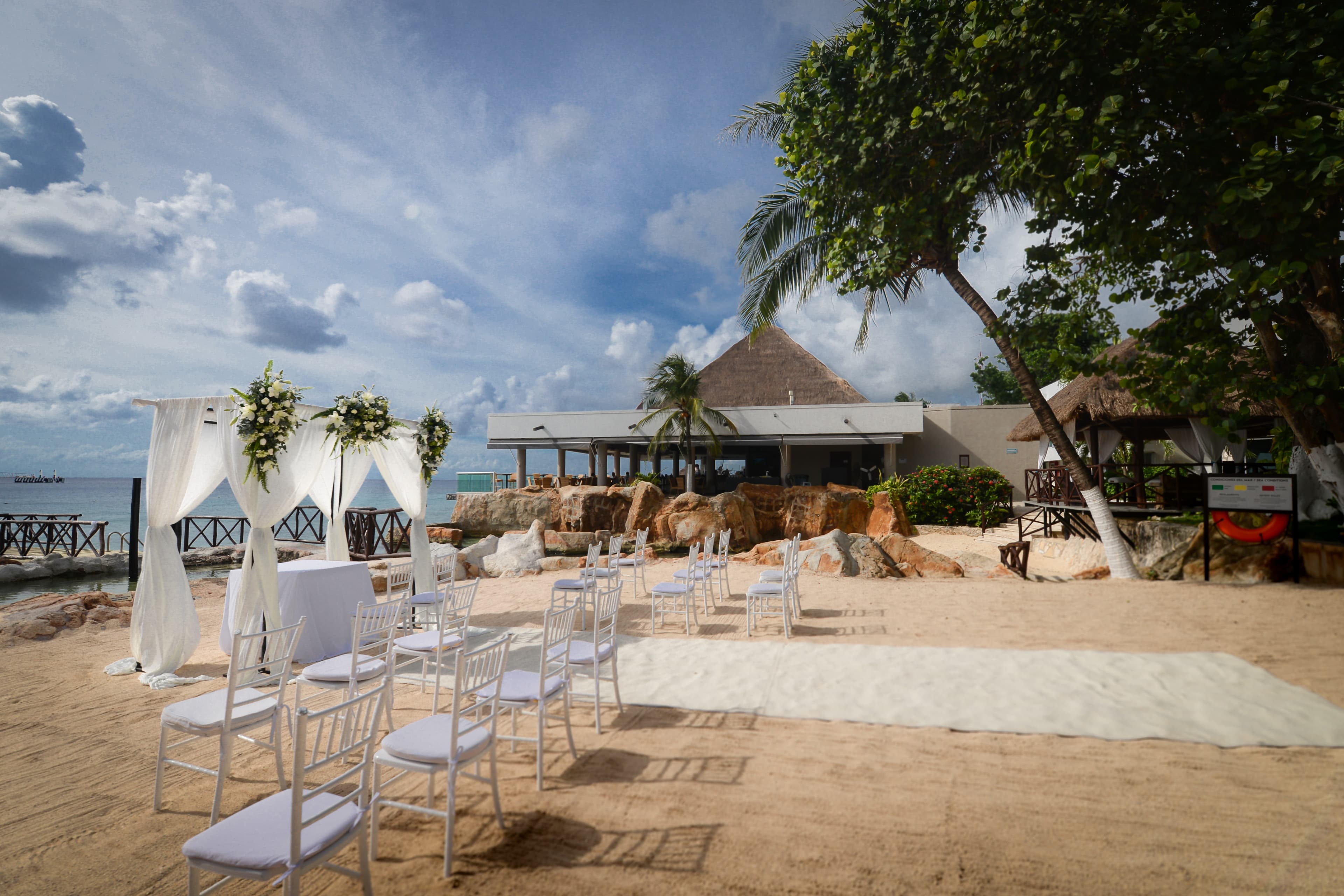
You can have the ocean in your photos without placing the ceremony on the sand. An elevated terrace overlooking the Caribbean, a cenote ten minutes away, a hacienda garden with beach access for your portrait session the next day. Your guest remembers the complete three-day experience, not the exact coordinates of your vows.
That flexibility, decided twelve months in advance, opens the cheaper months without punishing you. Decided two months out, it costs.
Where katiblé Enters This Decision
At katiblé your wedding doesn't live in a spreadsheet with random phone numbers: it lives inside, with your date, your guests, and your vendors all in the same place. Digital invitations for your guests are free.
And there's one element that changes the budget conversation entirely: what you spend with vendors on the platform returns part to you as cashback. With a destination wedding of twenty or more people, that return stops being symbolic. Your wedding can pay for itself, at least in part.
If you want to keep taking this down to numbers, the guide on how much a wedding in Riviera Maya costs and the one on beachfront and cenote venues will help. And if you're already at the guest stage, the guide on room blocks for destination wedding guests saves you the worst surprise of all.
What Is the Best Month to Get Married in Riviera Maya?
If you're seeking the highest probability of stable weather and clean ocean, December through April is the safest period, with March and April as the most balanced. If you're seeking the best balance between climate and price, November is the most interesting window of the year: the hurricane season has passed its active period, the dry season begins, and rates haven't yet reached December levels.
Can You Have a Wedding in Riviera Maya During Hurricane Season?
Yes, and many do. The official season runs June 1 to November 30, but the probability is uneven: the period of highest activity is mid-August to mid-October. What changes is not whether you can marry, but the level of preparation required: a covered Plan B contracted, a force majeure clause in writing, event insurance taken out in advance, and clear communication with your guests about flexible flight policies.
Which Months Have the Most Sargassum in Riviera Maya?
The season runs approximately May to October, with peaks concentrated between May and August according to UNAM monitoring. That said, sargassum is highly variable: it changes beach by beach and day by day, and there have been years with early arrivals outside the normal pattern. For this reason, it's wise to decide with recent monitoring reports and direct evidence from your venue, not a general average.
How Far in Advance Should I Book My Date?
It depends on which month you choose. For December through April—especially Christmas, New Year's, and Holy Week—competition for rooms and venues is high, so the conversation begins much earlier. For low season you have more flexibility, but advance booking still works in your favor for another reason: it allows you to negotiate Plan B, clauses, and room blocks from a comfortable position, rather than accepting what's left available.
Does It Make Sense to Marry in Low Season to Save Money?
It can make considerable sense, provided the savings don't vanish into unmanaged risk. Low season gives you more accessible rates, greater availability, and more room to negotiate for both you and your guests. The condition is that these savings come with a real Plan B, a contract with clear rescheduling rules, and—if your date falls in the active period—event insurance. Saving without these three pieces is not saving: it's gambling.
Your date also determines who can attend, not just how much it costs. It's worth cross-referencing it with your guest list before you lock it in.